University Degree or Apprenticeship: Which Path Actually Builds a Career Faster?
"University degree or apprenticeship? Compare cost, earnings, skills, job prospects, flexibility, and career growth to choose the right path after Class 12. See how degrees, apprenticeships, and a middle path can shape your career faster in India."
pooja
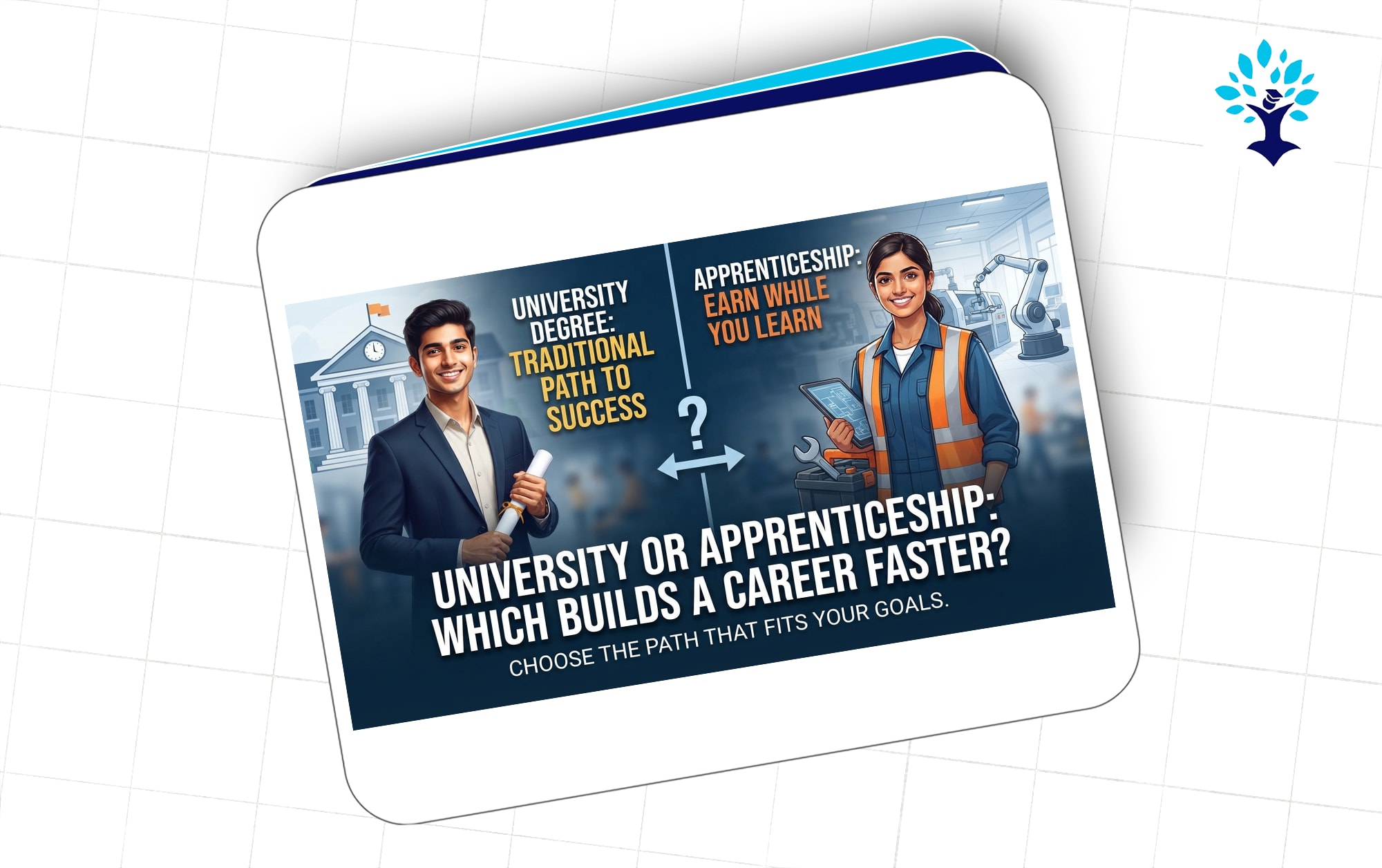
Which Path Actually Builds a Career Faster?
Somewhere around class 12, or right after, every student in India runs into the same wall. Parents want a degree because that's what respectable families do. Relatives keep asking which college you got into, like it's the only question that matters. And quietly, in the background, apprenticeship programs have started paying real stipends and leading to real jobs at the end, without three or four years of tuition fees attached to them. Nobody really sits you down and walks you through this as a decision worth thinking through on its own terms. It just gets treated as a formality on the way to adulthood, and most people go along with it without asking too many questions.
Here's the thing, though. Both paths can take you somewhere solid, and both can also lead nowhere, depending entirely on what you do with them once you're in. A degree from a mediocre college with no internships behind it isn't automatically worth more than a well-run apprenticeship at a company that actually bothers training its people properly. So let's actually get into what each path offers, minus the assumptions most families carry into this conversation without ever questioning them.
What a University Degree Still Gets You
A degree hasn't lost its value, whatever half the internet seems to be saying these days. For certain careers, it's still completely non-negotiable, and no amount of practical skill gets you around that. Medicine, law, chartered accountancy, core engineering, most government exams — these all need a specific degree just to qualify, and there's no shortcut worth chasing there.
Past the legal requirement, a degree gives you something apprenticeships usually can't match: a broader theoretical base. If research, higher studies abroad, or roles that need real conceptual depth (not just task execution) are on your radar, those years of theory tend to pay off eventually, even when it doesn't feel that way while you're sitting through a boring lecture at nine in the morning. There's also the peer network you build over three or four years on campus, which matters a lot more later than it seems to while you're still living it. And a general degree keeps more doors open if you honestly don't know yet what field you want to build a career in — which, at eighteen, is a completely fair place to be.
The catch, and it's a real one for a lot of Indian families, is money and time. A decent private college degree can easily run into several lakhs, and unless it's from a genuinely strong institution with solid placement support, there's no guarantee that money comes back to you. Plenty of graduates finish college and still spend a year or two struggling to find a job that even justifies what was spent getting there.
Why Apprenticeships Are Gaining Ground in India
Apprenticeships used to carry a bit of a stigma here — seen as the fallback for students who couldn't get into a decent college. That perception has been changing fast, and honestly, for good reason.
The obvious one first: you earn while you learn, instead of paying tuition for years with nothing coming back in. Training is hands-on, tied to what employers actually need day-to-day, rather than a syllabus someone wrote a decade ago and never bothered updating. A lot of programs, especially ones running under the National Apprenticeship Promotion Scheme, lead straight into full-time roles at the same company once training wraps up, which cuts out a huge chunk of the job-hunting stress that fresh graduates deal with. You also start building real work experience and a professional network years before your degree-holding friends even graduate — and that gap compounds by the time everyone hits their mid-twenties. Right now, manufacturing, IT support, retail operations, banking, and skilled trades are all expanding apprenticeship intake, so it's not like opportunities are thin on the ground anymore.
The trade-off, and it's worth being upfront about it, is that apprenticeships are narrower by nature. You're trained for one role or one industry, which is great if that's genuinely where you want to end up, but it can box you in a bit if you decide a few years down the line that you want to try something completely different.
The Questions That Actually Decide Which Path Fits You
Before picking either route, it's worth sitting with a few honest questions instead of just copying whatever the people around you happen to be doing. Do you already know the field you want to work in, or are you still figuring that out? Does your target career legally require a degree — because if it does, there's not much left to debate. Can your family comfortably afford several years of tuition, or would that time and money serve you better going toward earning while you learn? Do you actually learn better sitting through structured theory, or by doing the real job with someone experienced showing you the ropes? And how much does having a degree certificate matter for family or social reasons in your particular situation?
That last one isn't exactly practical, but it's real for a lot of households in India, and there's no shame in letting it factor into the decision instead of pretending it doesn't exist. There's also a middle path a lot of students never even consider: doing a degree through distance or part-time mode while working an apprenticeship or entry-level job at the same time. It's more demanding — you'll lose some evenings and weekends to it — but it gets you the paper qualification and the real-world experience together, without losing years of income in the process. If neither path feels completely right on its own, this one's worth a proper look.
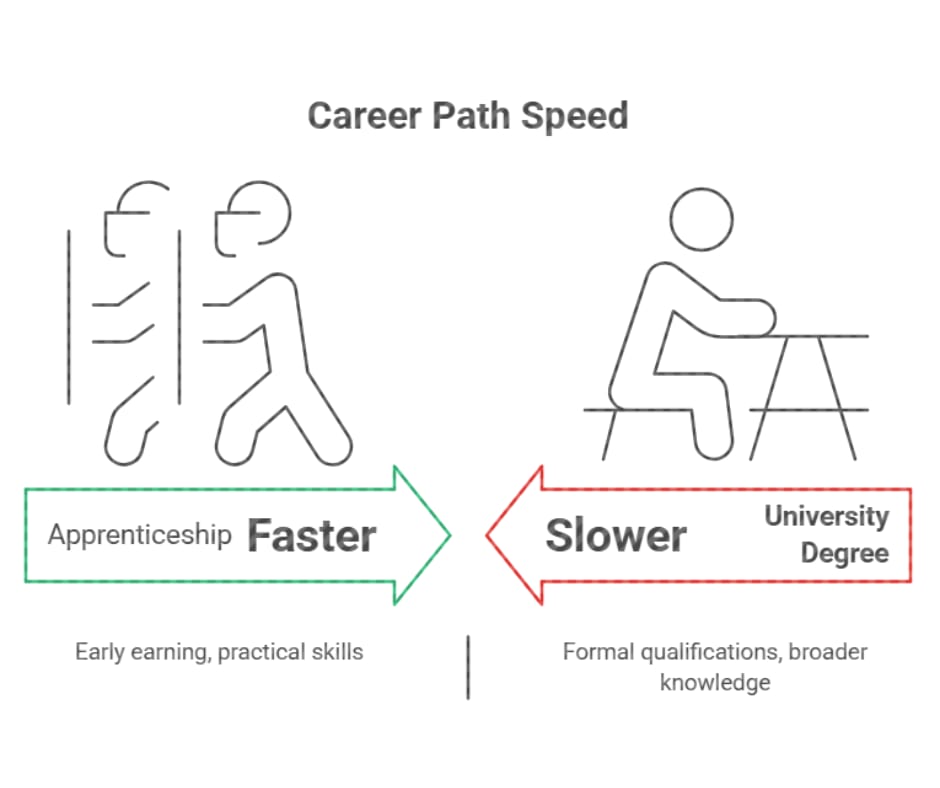
What Recruiters in India Actually Look At
Here's something worth knowing before you make up your mind either way. For most private-sector jobs outside the regulated professions, recruiters increasingly care more about what you can actually do than which college your degree came from. That shift is part of a much bigger change in hiring, because the job search has quietly changed as employers increasingly look beyond traditional qualifications. A candidate with two years of apprenticeship experience and a diploma often gets picked over a fresh graduate with a degree but no practical exposure, especially for roles in operations, technical support, retail management, and skilled trades. Government jobs and PSU roles are the big exception here — their eligibility criteria are locked to specific degrees and generally can't be swapped out for apprenticeship experience, no matter how strong that experience is.
How to Actually Find a Good Apprenticeship
If an apprenticeship sounds like the right call after all this, the next challenge is finding one that isn't just cheap labour wearing a nicer title. The National Apprenticeship Promotion Scheme portal is a decent place to start — it lists verified opportunities across sectors, along with the stipend and duration for each. Big manufacturers, PSUs like BHEL and ONGC, and private companies across banking and IT support all run structured programs through this route, and the stipends attached are regulated rather than left up to whatever a company feels like offering.
Before saying yes to any apprenticeship, check a few things that separate a genuinely useful program from a weak one. Ask how many past apprentices from that same batch actually got absorbed into full-time roles — that one number tells you more than any glossy brochure will. If a company doesn't give you a clear answer, a polite follow-up can sometimes get you the information you need, especially when you know the follow-up email that actually gets a reply. Ask if there's a dedicated trainer or mentor for apprentices, instead of getting passed off to whoever's free that week. And check whether the stipend actually matches what's listed on the official scheme portal, because a few companies quietly pay less than the regulated minimum to candidates who never bother verifying it.
ITIs — Industrial Training Institutes — and other skilling platforms are also worth a look alongside apprenticeship listings, especially for trades like electrical work, fitting, welding, and machining, where ITI-trained apprentices stay in steady demand across manufacturing hubs in states like Gujarat, Tamil Nadu, and Maharashtra. These routes almost never get the attention college admissions season does, but for the right person, they lead to stable, well-paying careers a lot faster than a four-year degree ever could.
Final Thought
There's no universally right answer between university and apprenticeship — only the answer that actually fits where you're starting from and where you're trying to end up. If your career depends on a licensed profession, the degree is the only real path forward, and fighting that isn't worth your energy. But if you already know your field and want to start earning while you learn it, a well-chosen apprenticeship can put you years ahead of your degree-holding peers by the time you hit twenty-five. Pick based on the career you're actually chasing, not the path everyone around you took just because it's the one they happened to take. And once you start applying, be ready for the hiring process itself to look different too, with more companies using formats such as virtual interviews in 2026.
Related Articles

10 Resume Mistakes That Are Quietly Costing You Every Interview
"Discover the 10 common resume mistakes that silently cost candidates interviews. Learn how to improve your resume, stand out to recruiters, and increase your chances of landing more job opportunities."
6 min read

Your LinkedIn Profile Is Working a Night Shift — Make Sure It's Actually Good at the Job
"Recruiters spend just seconds reviewing LinkedIn profiles. Learn how to Optimize your photo, headline, About section, skills, and experience to increase profile views, recruiter interest, and job opportunities."
6 min read
Should You Let AI Write Your Resume? Here's the Honest Answer Nobody's Giving You
"Everyone's using AI to write resumes—but should you? Here's the honest truth about what AI gets right, where it backfires, and how to create a resume that impresses both ATS systems and human recruiters."
7 min read